
XFX 9600GSO 384mb vs Sapphire HD4670 512mb

Conclusion
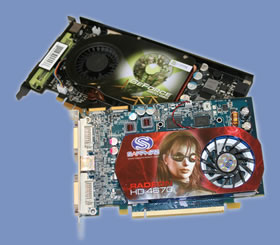
Published: 20th September 2008 | Source: Overclock3D | Price: ~£70 |

- Small
- No external power needed
- Good at high res
The Mediocre
- Aluminium Heatsink
The Bad
- Noisy fan
Most Recent Comments
Registered because I found this review curious, and it's not only this one about the 4670. I think that in the rush of comparing price and performance, many reviewers usually put against the HD4670 the 9600GSO, forgetting other fundamental things;
1-the cards are of totally different sizes and the 9600GSO won't fit many standard OEM cases while the 4670 will.
2-The HD4670 consumes far less power, with no 6 pin connector, so I'd not consider an aluminum heatsink mediocre when power consumption is also mediocre compared to the rival card.
Despite being similar in price or performance, I think we're comparing very different cards, for different target buyers. With the 4670 you can be sure you can upgrade almost any HTPC or any Dell or HP case, without worrying about your card intersecting something. The HD4670 is maybe the most important card of this year because after the HD2600/3600 and GF8600 fiasco, it's the first mainstream card in mainstream format in a long time (small PCB, no 6pin power) and it's most direct competitor should be the 9500GT (which is not) while the 9600GSO is better aligned with the HD3850.
In this perspective nvidia is still sadly falling short of the objectives even in the midrange and as of direct competition, I'd rather see the HD4670 leading alone for the moment.
Yeah it's pretty much Red all across the board atm.
Nvidia took a right chance with the GT200 with its huge die size - it's not exactly cheap for the them to make, and thanks to their price drops you can be sure they're not selling them for much of a profit anymore.
ATi's RV770 was a much better chip in many respects, it performs great and it's a lot cheaper for the them to make (55nm V 65nm and a much smaller die).
1-the cards are of totally different sizes and the 9600GSO won't fit many standard OEM cases while the 4670 will.
2-The HD4670 consumes far less power, with no 6 pin connector, so I'd not consider an aluminum heatsink mediocre when power consumption is also mediocre compared to the rival card.
You make some good points X-thing, welcome to the forum too!
While I agree the cards are different sizes, the performance and price are still similar which make for a valid comparison. I agree that they could be considered for different markets, SFF being one of them and as such this was also mentioned in the review. However, when someone goes shopping, especially someone not willing to spend vast amounts of cash, will surely want to see how much performance they can get for their cash, bang per buck as it were and so the cards were compared on this basis.
I criticised the use of aluminium as if they had used copper then the fan might not have spun up so fast, making for more efficient cooling properties. As you previously pointed out, buyers of SFF and media centers etc may well be considering this card. If it were me shopping for such a card, I would want a near silent cooler, which sadly the 4670 has not, due in part to the aluminium heatsink.
We couldn't really compare the 9600GSO against the 3850 as that card is previous generation so would be unfair and to be quite honest uninteresting. Apart from the fact, we do not always have every card in this and the last generation from which to choose.
Not particularly this but as I said before, many other sites the put the 4670 too much on the personal with the GSO. Yes especially where I live or in the USA it is an absolute steal, however, there are other scenarios the 4670 is the way to go and maybe that could have been made clearer in the conclusions, because it's there that most people jump before reading the whole review and sometimes it does not just "come down to what screen you are looking to game on"; I couldn't use my HD3850 in my sister's 350W PSU PC, and had to swap it with a 4670 first. People seeking quad display with graphics performance will get lots of power savings and cooler systems with two of them compared to two 9600GSOs or 3850s.
The fan is loud, yes, that aluminum heatsink is Sapphire's way to spare some money,the stock cooler is much better. I have also seen a dual slot version from asus, big silent fan on top, that should be nice for HTPCs.
Anyway, let me say that your review was very precise and well made,was interesting to see the slight superiority of the 9600GSO, with the 4670 taking over @ high resolutions, probably because of the 512M of RAM vs 384 of the GSO.
P.S: Just a small question on the sapphire cooler, was it loud or very loud, because I think this is the model I am getting to replace the 3850.
If u turn ur pc on, play a game, then turn off - the ati draws less power.
If u have ur pc on, browse, do simple desktop stuff, leave it on, play games, then leave it on or off really - the nVidia will draw less power.
Apparently, the ATI card draws less power under full load. Whilst at idle, the nVidia draws less.
If u turn ur pc on, play a game, then turn off - the ati draws less power.
If u have ur pc on, browse, do simple desktop stuff, leave it on, play games, then leave it on or off really - the nVidia will draw less power.
That is because ATi hasn't fixed that stupid powerplay driver on the 4000 series, maybe they did it with the last catalyst 8.9.
i tried out the ati overdrive utility yesterday and i will post my highest stable overclocks below.
core: original:750mhz final:860mhz
memory: original:2008mhz final:2320mhz
note: i am willing to bet others on this forum with better tools could likely put my overclocks on this card to shame.
ive found that this card is a great preformer.
ps: i tested the cards overclocks with several hours of playing oblivion and unreal tournament 3 i had no artifacts or problems.
im out for this post and i wish you guys the best of luck with you overclocking adventures!!
core: original:750mhz final:860mhz
memory: original:2008mhz final:2320mhz
note: i am willing to bet others on this forum with better tools could likely put my overclocks on this card to shame.
I'd rather think you've been quite lucky with that card because more or less all review sites around have not been able to get much further of 800 MHz for the core and 2100MHz for the memory. What brand was it?

Anyway another great review btw. :)
Just curious, do you find reviewing fun or is it pretty routine after a while?