Asus P67 1155 Sandybridge Sneak Peak
A New BIOS - EFI you say?
Published: 14th November 2010 | Source: Asus | Price: |

A New BIOS
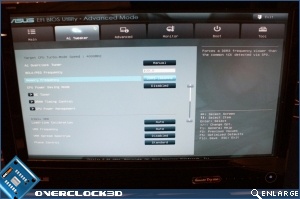
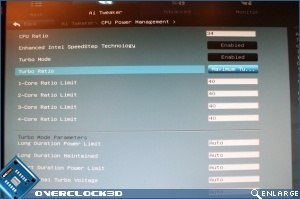
The Asus P67 range finally brings conventional desktops into the new millenium with EFI BIOS technology. For the end user, the key difference in the new format is its GUI based interface.
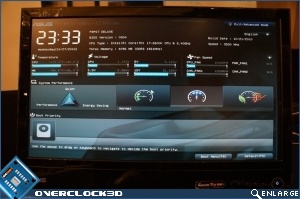
However there is a big difference between this BIOS and other EFI implementations. The entire P67 range offers an Easy (left) and Advanced (right) mode for BIOS users. The former consolidates all important information into a single page and allows the end user to manipulate a number of useful parameters such as power saving modes and boot priority (that's right, no more F8 tapping). The advanced mode shares a near identical layout to the Asus BIOS' of the past. Regardless, even those who have not as yet played with a system BIOS will find the menus intuitive and very self descriptive.
On a similar note, ROG based motherboards will also feature a BIOS Print Screen feature. As you can imagine this makes it considerably easier to share BIOS parameters with others. Infact, as reviewers it also makes our lives considerably easier!
Overclocking with Asus and Sandy Bridge - Gifts & Curses...
The Maximus IV Extreme on demo offered a wealth of system tweaking parameters. Whether you are looking to push memory upwards of 2000MHz or simply push your processor for all its worth, there will surely be something for you.
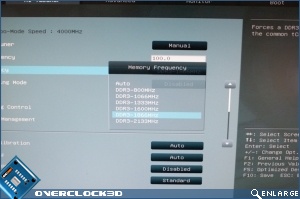
Two of the most noteworthy options are as above.
Previously, the LGA1156 and 1366 platforms have offered DDR3 frequencies up to 1333 and 1600MHz at their base clock frequencies. This has changed significantly with LGA1155 where frequencies as high as DDR3-2133 are natively supported. Next up is the ability to manipulate individual core multipliers on this K series Sandy Bridge processor.
Many of us believe that "good things" happen for a reason, and god almighty there is most certainly a reason for some of the above features.
There is only so much that we can disclose, but at this point it is known that there will be Intel Dual/Quad processors that are fully multiplier unlocked, while the vast majority will be (partially or entirely) locked down. Very well, this may sound as though it is business as usual but it really isn't. While we were unable to confirm this for ourselves, we were informed that overclocking the Base Clock Frequency of the new Sandy Bridge processors is a rather fruitless endeavour. Quantatively it was said that we could expect these processors to reach their limits at just 115MHz (15% above their BCLK of 100MHz). Clearly the tables have turned; the emphasis of multiplier overclocking is here.
This may not be such a bad thing as for all we know, Intel may do an "AMD" by making one in three processors multiplier unlocked. Sadly one thing we do know is that the overclocking ball has landed squarely in Intel's court. How much will the end user have to spend for the priveledge of overclocking? Only time will tell...
Most Recent Comments
NDA?
HARUMPH.
http://www.youtube.com/watch?v=JN99jshaQbY
i should of done Prt Scr
or at least the M4E does
i knew it
The new BIOS thing is the UEFI (Unified Extensible Firmware Interface). Should provide faster boots and pretty up the settings quite a bit. Will probably be initially shunned by purists as you can use a mouse and it means people will become less afraid of the BIOS and overclocking etc.
|
The new BIOS thing is the UEFI (Unified Extensible Firmware Interface). Should provide faster boots and pretty up the settings quite a bit. Will probably be initially shunned by purists as you can use a mouse and it means people will become less afraid of the BIOS and overclocking etc. |
I remember when I was younger it was a big thing for parents to keep their children out of the bios
I can see this becoming a big thing again, In the end I imagine it will just come down to passwording it but still.
|
That explains why I read about this earlier and now can't find it anywhere! The new BIOS thing is the UEFI (Unified Extensible Firmware Interface). Should provide faster boots and pretty up the settings quite a bit. Will probably be initially shunned by purists as you can use a mouse and it means people will become less afraid of the BIOS and overclocking etc. |
I was hoping for a date.
Even tho it was what I expected lol
looking forward to it

I really really like the new UEFI BIOS.
As to the maxiumus they have always appeared to be the ugly members of the ROG family and things dont appear to have changed on the plus side I'm pleased to see ceramic heatsinks, the negative being it looks like they've just slapped the ROG light up logo on it and called it a day. Yeah I know its just aesthetic but if I'm paying good money for a motherboard I'd at like it to look as good as this generations ROG motherboards. Though this being said next year should be very interesting, two new sets of Intel chips at either end of the year and AMD's new chips sometime next year aswell should be a very good (and expensive year) for us enthusiasts.
I didn't know the 1155 i7's would have the HD Graphics in them but looking on wiki's "List of future Intel microprocessors"
Core i7-2600S Quad Core, 2.8 GHz, 3.8 GHz Turbo, 8 MB, HD Graphics 100, GPU Frequency: 850-1100 MHz, 65 W, LGA 1155, Release Date Q1 2011.
Core i7-2600 Quad Core, 3.4 GHz, 3.8 GHz Turbo, 8 MB, HD Graphics 200, GPU Frequency: 850-1350 MHz, 95 W, LGA 1155, Release Date Q1 2011.
Core i7-2600K Quad Core, 3.4 GHz 3.8 GHz Turbo, 8 MB, HD Graphics 200, GPU Frequency: 850-1350 MHz, 95 W, LGA 1155, Release Date Q1 2011.
Full List of future Intel microprocessors
But yes I agree with wraithien that it looks like a expensive year.
With i3/5/7, 55/58, Intel are still only claiming somewhere around a quarter of their own socket sales to this generation. Meanwhile 775/1 still occupies around two thirds - which is massive in consideration.
(this would be total Intel shipments of their own sockets)
We had to consider, throughout the Intel wish for as all to lever away from the LGA 775, that mobos themselves, apart from chipsets, will be going through changes. Not only was their the hapless introduction of ddr3, which in tech terms goes against logic along with tri-core processing, but there was SATA3 and USB3 on the immediate horizon.
In fairness, the newer generation of the Intel offering, boast some decent tech in it's own right, and as a purchasable item where no existing items (775) were in attendance, apart from the total outlay of cash to consider, you have again a really good system.
But, in the same breathe, if you're nothing short of a professional workstation, there's not really a great point in abandoning your 3.8-4ghz 775 setup, with decent memory and atleast a single Pcie 2.0 x16 slot.
Progress ? Arguable. I can remember shooting the breeze in hard benchmarking terms with a fellow oc3der with his top of the range i7 setup and the extreme 775 I had, with crap memory I hasten to add which negates the extreme rating really. Sure the i7 could keep up and beat the 775 arrangement in many facets - but by really small comparitive amounts. Flip this to the pov of the gamer, and there's nothing in it.
Hyperthreading, multiple cores - again professionally they mean something, also with benchmarking. Other than that, if you're in posession of a really good 775 - no point.
So in Intel's defense, if I can call it that, they are left to squeeze existing socket users into adopting the new one. Eol on cpus and the promise of Pentium class replacements only is fairly scary. And yet to this day - a quarter share.
Many would have understandably skipped i3/5/7, and we have some new offerings. But how well do these compare, across the board with the legendary 775 ? I'm expecting the same comparisons. Workstation professionals - great. Gamers/internet'ers - no point unless you have to.
And of course, we'll rush out for the 67 chipset, feel nice and warm - and just like SATA3/USB3 - the breaker of the deal will be PCie 3.0.
New mobo ? Give me Pcie 3.0/full SATA3/full USB3/DDRx (QUAD channel). Perhaps next year.
Interesting.


Continue Reading